

Table of Contents
Understanding Market Research Methods
In today’s competitive digital landscape, effective market research methods are essential for service businesses and online brands in North Carolina and the Mid-Atlantic region. At CloudnBugs, we leverage these systematic approaches to gather insights on customer needs, market trends, and competitive landscapes, informing strategies for website optimization, e-commerce enhancements, and SEO efforts.
Market research methods divide into qualitative research methods, which explore behaviors and motivations through in-depth discussions, and quantitative research methods, which measure data through structured metrics. The four primary types include surveys for broad data collection techniques, interviews for personalized customer insight strategies, focus groups for group dynamics, and observation for real-time behaviors. These methods enable data-driven decisions, reducing risks and identifying opportunities, as evidenced by studies showing businesses using market research achieve up to 20% higher success rates.
For instance, we apply these techniques to optimize WordPress sites for contractors in Raleigh, North Carolina, boosting conversions through targeted SEO and user experience improvements.
1. Surveys for Actionable Insights
We recommend surveys as a cornerstone of marketing research methods, enabling service businesses to gather quantitative data efficiently. As one of four core market research methods, surveys provide structured questionnaires distributed online or via email to collect large-scale feedback on consumer preferences and behaviors. This approach supports digital strategy decisions, particularly for e-commerce and SEO optimization.
In quantitative research methods, effective survey design includes clear, unbiased questions using Likert scales or multiple-choice formats to ensure statistical validity, as noted in marketing research resources. Distribute them through email campaigns or website pop-ups for broad reach, targeting clients like retailers in Durham, North Carolina. Analyze responses with tools like Google Forms or SurveyMonkey, applying statistical software for survey-based analysis and numerical feedback techniques. This yields actionable insights into website user satisfaction, tying directly to improved conversion rates and digital growth. However, low response rates—often below 20% per benchmarks—pose challenges; we advise incentives to boost participation.
For instance, CloudnBugs recently conducted a survey for a Raleigh contractor’s site, revealing key pain points in user navigation that informed targeted SEO tweaks. Tip: Select user-friendly tools with built-in analytics to streamline the process from distribution to actionable insights.
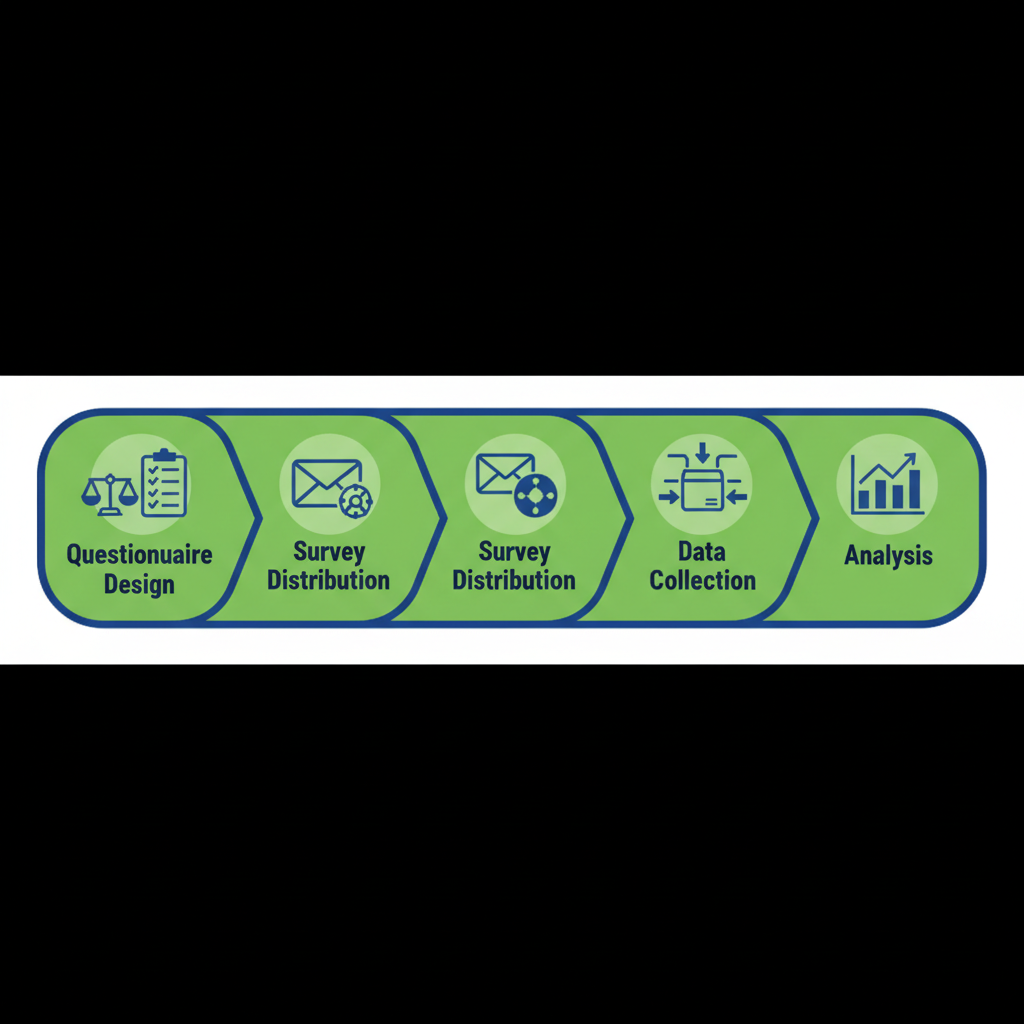
Survey process infographic for actionable market research insights
2. Interviews for In-Depth Perspectives
Building on the breadth of surveys, interviews offer a powerful tool within market research methods to delve into individual experiences. These one-on-one conversations reveal nuanced motivations and pain points that quantitative approaches often miss, providing qualitative depth essential for customer-centric strategies.
Interviews come in structured, semi-structured, and unstructured formats, each suited to different research goals. We at CloudnBugs prepare by selecting diverse participants, such as e-commerce users from Arlington, VA, and scripting open-ended questions. Key steps include:
- Identifying target respondents based on demographics and behaviors.
- Conducting sessions via video calls for rapport building.
- Recording with consent for accurate transcription.
Post-interview, we apply thematic analysis to uncover patterns, contrasting this qualitative research methods approach with surveys’ numerical data for comprehensive insights. As noted in market research resources, this method enhances competitive positioning for small businesses by uncovering unmet needs, much like how companies use market research competitive analysis to refine offerings.
For example, in client consultations in Wilson, North Carolina, we interviewed users to improve e-commerce user experience, revealing navigation frustrations that boosted conversions. A tip for narrative insight collection: Use probing questions like “Can you walk me through your last purchase?” while ensuring confidentiality to build trust and ethical compliance.
3. Focus Groups for Collective Feedback
Building on individual interviews, focus groups offer a dynamic way to capture collective feedback through moderated discussions. As one of the key market research methods, this qualitative approach reveals group interactions and shared preferences, helping North Carolina service businesses refine their digital strategies.
We typically assemble 6-10 participants representing target demographics, such as local retailers or event planners in Maryland. A skilled facilitator employs group discussion strategies to guide conversations, ensuring balanced input. Sessions last 60-90 minutes with this agenda:
- Icebreakers to build rapport
- Core questions on website usability and features
- Probes for deeper insights into pain points
- Wrap-up for final thoughts
Post-session, we analyze transcripts for emerging themes like collaborative insight generation on e-commerce navigation. For instance, CloudnBugs conducted focus groups testing UX for a Maryland event venue, uncovering preferences for streamlined booking flows. Success hinges on neutral moderation to counter dominant voices, as group dynamics directly inform strategic decisions—enabling businesses to understand their audience and make data-driven choices, per market research experts.
A key tip: Recruit via targeted social media ads for diverse, engaged participants to yield actionable results.
4. Observation for Authentic Behaviors
Observation stands out among market research methods as a powerful way to capture authentic user behaviors without direct interference. By unobtrusively monitoring interactions, we gain insights into how visitors navigate websites, revealing patterns that inform targeted SEO strategies for regional brands.
This method blends qualitative research methods for contextual understanding with quantitative research methods for measurable data. We differentiate participant observation, where researchers engage subtly, from non-participant approaches that maintain complete detachment to minimize the observer effect bias. Tools such as heatmaps and session recordings enable precise tracking of clicks, scrolls, and dwell times, allowing us to identify behavioral trends. These empirical observation tactics help interpret user intent, optimizing site elements like navigation for better search performance and lead generation, as supported by primary research techniques in marketing analysis.
At CloudnBugs, we apply these behavioral tracking approaches to analytics for home service sites in Raleigh, North Carolina. For instance, heatmaps on a contractor’s platform uncovered overlooked service pages, boosting visibility. Tip: Integrate tools like Hotjar for real-time insights, ensuring unbiased pattern recognition to refine user experiences effectively.
5. Secondary Research for Foundation Building
At CloudnBugs, we begin our digital strategy development with secondary research, a key market research method that leverages existing data to quickly establish market context for e-commerce clients in North Carolina. This approach provides an efficient foundation, allowing us to identify trends without the initial investment of primary data collection.
Secondary research draws from diverse sources to aggregate insights through quantitative research methods. Key resources include:
- Government reports and databases, such as those from the U.S. Small Business Administration, offering free access to demographics, economic indicators, and industry statistics.
- Industry articles and academic publications for broader trend analysis.
We synthesize this data using archival analysis methods, focusing on patterns in consumer behavior and competition. Its advantages lie in low cost and speed, enabling rapid competitive analysis for WordPress clients like those in Smithfield. However, we caution that data may lack currency or full relevance, requiring validation against current conditions.
For instance, in supporting an investigative firm, we applied existing data utilization to refine SEO strategies, as detailed in our eatmon associates case study. Always cross-check sources for timeliness to ensure actionable insights lead effectively into hypothesis-testing experiments.
6. Experiments for Hypothesis Validation
Market research methods like experiments provide rigorous validation for digital marketing ideas, especially for service businesses in the Mid-Atlantic seeking growth. These quantitative research methods offer controlled environments to test hypotheses, delivering empirical evidence that outperforms qualitative approaches in precision and scalability.
Experiments, such as A/B testing and multivariate setups, involve comparing variations in website elements to measure impact on user behavior. Key variables include headline copy, button colors, or layout designs, with metrics like click-through rates, conversion rates, and bounce rates tracked for evaluation. Achieving statistical significance requires sufficient sample sizes to ensure reliable outcomes, often using tools like Google Optimize. We emphasize ethical randomization to avoid bias, aligning with best practices from industry sources on outcome measurement in field trials.
For instance, at CloudnBugs, we conducted A/B tests on the bq grills online store in Arlington, Virginia, optimizing product pages to boost engagement. Tip: Aim for at least 100 conversions per variant in controlled testing protocols for valid empirical validation techniques.
7. Case Studies for Practical Lessons
We often learn the most from real-world successes and setbacks, making case studies a powerful tool within market research methods. These narrative learning tools provide in-depth case examinations of past projects, offering transferable insights for website and SEO optimization in local businesses like those in North Carolina.
As a qualitative research method, case studies follow a structured narrative: selecting relevant projects based on criteria such as industry relevance and outcome diversity, then detailing challenges faced, innovative solutions implemented, and measurable results achieved. At CloudnBugs, we analyze our portfolio to extract lessons for retailers, emphasizing thorough documentation to ensure accuracy. While rich in interpretive depth, these differ from quantitative research methods by focusing on context over statistics, with limits on broad generalization due to their specificity.
For instance, our pimp shrimp shopify case study showcases how we built a clean, user-friendly Shopify store for a North Carolina apparel brand, boosting navigation and sales through targeted e-commerce features. A key tip: Always prioritize ethical documentation to protect client privacy and enhance credibility.
8. Competitor Analysis for Edge Gaining
Competitor analysis stands out among market research methods as a powerful hybrid approach, blending qualitative research methods for insights into rivals’ strategies with quantitative research methods to measure performance metrics. At CloudnBugs, we leverage this to help our service business clients in North Carolina gain a strategic edge by refining their digital offerings.
This method involves evaluating competitors’ online presence through tools like SEMrush for keyword rankings and traffic data, and SWOT frameworks to assess strengths, weaknesses, opportunities, and threats. Benchmarking identifies performance gaps, such as slower site speeds or weaker SEO, while ethical boundaries ensure we avoid unauthorized data access. For our clients, like contractors in Durham, North Carolina, we apply this to SEO audits, revealing opportunities to outrank local rivals. As the U.S. Small Business Administration notes, key steps include analyzing market share and barriers to entry for sustainable revenue advantages.
In practice, we conduct CloudnBugs-specific rival benchmarking tactics quarterly for Durham clients, using competitive intelligence gathering to spot SEO gaps in lead generation. We recommend ongoing monitoring every three months to adapt to market shifts and maintain your digital superiority.
Integrating Research for Business Growth
Market research methods provide essential tools for service businesses and online brands across North Carolina and the Mid-Atlantic to uncover customer needs and market dynamics. By recapping the four primary types—customer, product, brand, and competitor research—alongside additional approaches like experiments and competitor analysis, businesses can select tailored strategies aligned with goals such as SEO and e-commerce optimization.
Integrating qualitative research methods for deep insights with quantitative research methods for measurable data creates holistic data strategies. This multi-method framework reduces risks, improves forecasting, and delivers ROI through informed digital decisions, as evidenced by strategic market analysis practices.
At CloudnBugs, we partner with you to implement these insights via our Google Places and SEO consultations. Let’s make something great together to drive your growth.
Resources
- Discover Eatmon Associates Investigative Website Case Study
- Explore BQ Grills Custom E-commerce Website Launch
- Learn Pimp Shrimp Clothing Shopify Store Development
- Optimize Business Visibility with Google Places Consultation
- Enhance Local Rankings via Google Places Optimization
- Get Professional Website Design in Smithfield NC
- Boost Website SEO with Yoast Consultation Services
- Learn Comprehensive Market Research Methods and Benefits
- Explore Effective Marketing Research Methods for Insights
- Conduct Market Research and Competitive Analysis Guide
- Discover Top Methods of Marketing Research Techniques
- Master Market Research Strategies and Best Practices